Stainless Steel Gas Pipe has moved from being a niche specification to one of the most requested materials in residential, commercial and light industrial gas distribution. The reason is not marketing — it is chemistry. Stainless steel does not flake, does not produce loose rust that migrates downstream into valves and meters, and does not become brittle after years of contact with the odorant compounds used in utility gas. When engineers ask can stainless steel pipe be used for natural gas, they are usually asking a second, unspoken question underneath it: under which conditions, with which wall thickness, and with which joining method. Those three variables decide everything.
This guide collects the material specifications, dimensional limits, cutting procedures, prohibited materials and quality-control checks that matter when Stainless Steel Gas Pipe is specified for natural gas service. It is written for installation contractors, mechanical engineers, facility managers and project teams who need numbers rather than slogans.
Can Stainless Steel Pipe Be Used for Natural Gas? The Regulatory Answer
The short answer is yes, and the longer answer is that approval is conditional. Stainless steel is not a single material — it is a family of alloys with different chromium and nickel contents, different yield strengths and different behavior under chloride exposure. A pipe that performs flawlessly in an inland dry-gas system may fail prematurely in a coastal or industrial atmosphere if the wrong grade is selected. That is why every recognized gas code treats stainless steel as an approved but specified material rather than a blanket substitute for carbon steel.
In North American practice, the relevant documents are NFPA 54 (National Fuel Gas Code), ANSI LC 1 / CSA 6.26 for Corrugated Stainless Steel Tubing, and ASME B31.8 for transmission and distribution piping. In European practice, EN 10305-1 covers cold-drawn seamless stainless tubes, while EN 10216-5 governs seamless tubes for pressure purposes. In Chinese practice, three standards dominate: GB/T 14976 for seamless stainless steel tubes for fluid transport, GB/T 12771 for welded stainless steel tubes for fluid transport, and YB/T 4370 for welded stainless steel tubes used specifically in city gas distribution. A pipe purchased for a gas project should cite at least one of these standards on its mill certificate.
The conditions that make approval possible
Several conditions repeat across nearly every jurisdiction. The pipe must be manufactured to a recognized fluid-transport standard. The grade must be austenitic, typically 304 or 316. The wall thickness must meet a minimum for the intended location — risers, buried runs, and indoor drops each carry different minimums. The joining method must be one that produces a joint at least as strong as the pipe itself, or a mechanically compressed joint tested to a published standard. Finally, the finished system must be pressure-tested and, where a conductive flexible product is used, electrically bonded to the building grounding electrode system.
Grade Requirement
Austenitic grades 304, 304L, 316 and 316L cover almost all gas service. 316 is preferred where chlorides, coastal humidity or industrial vapors are present.
Standard Requirement
Seamless tube to GB/T 14976 or EN 10216-5, or welded tube to GB/T 12771, YB/T 4370, ASTM A269 or ASTM A312 depending on the market.
Joint Requirement
Welded, brazed with filler melting above 538°C, flared, or mechanically pressed with fittings qualified to ANSI LC 4 / CSA 6.32.
What Is the Best Pipe for Gas Lines? A Material Comparison
What is the best pipe for gas lines? is a question without a single correct answer, because the best material depends on where the pipe will live. A pipe running through a dry, protected indoor chase has a different duty cycle from a pipe buried in wet, sulfate-rich soil or a pipe mounted on an exterior wall exposed to salt spray. The table below compares the five materials most often evaluated for gas service, using the characteristics that actually drive long-term cost: design life, corrosion resistance, installation flexibility, joining complexity and maintenance burden.
Material
Governing Standard
Minimum Wall or Size Rule
Typical Design Life
Primary Strength
Primary Limitation
Black Steel Pipe
ASTM A53 / A106
Schedule 40 minimum
40 to 70 years
Very high mechanical strength, low material cost
Rusts in wet or buried conditions, requires protective coating
Corrugated Stainless Steel Tubing
ANSI LC 1 / CSA 6.26
Per manufacturer listing
30 to 50 years
Flexible, few joints, fast routing through framing
Requires bonding, must be protected from abrasion and sharp edges
Stainless Steel Gas Pipe (316)
GB/T 14976, YB/T 4370, EN 10216-5
Riser 3 mm, service entry 3.5 mm
50 years and beyond
Chloride resistance, high-temperature tolerance, no loose corrosion product
Lower yield strength than carbon steel, higher material cost
Copper Tube
ASTM B88 Type K or L
Type K or L
Approximately 50 years
Easy to bend and solder, familiar to installers
Restricted where hydrogen sulfide exceeds 0.3 grain per 100 scf
Polyethylene Pipe
ASTM D2513
Per wall-thickness designation
50 years and beyond
Excellent for direct burial, no corrosion, low installed cost
Not suitable for above-ground exposed service, requires tracer and transition fittings
Design life comparison in visual form
Estimated service life under typical gas distribution conditions, years
Black Steel Pipe
55
Corrugated Stainless Steel Tubing
45
Stainless Steel Gas Pipe 316
65
Copper Tube
50
Polyethylene Pipe
60
The visual comparison makes one point clearly: no single material dominates every column. Black steel wins on mechanical strength and cost. Polyethylene wins on buried installation economics. Corrugated Stainless Steel Tubing wins on routing speed. Stainless Steel Gas Pipe wins on corrosion resistance and service life in aggressive environments, which is why it is specified where replacement access is difficult or impossible — inside occupied walls, inside prestressed slabs, inside tunnels, and on exterior facades in coastal zones.
Stainless Steel Gas Pipe Grade Selection: 304 Versus 316
The two austenitic grades that appear most often in gas specifications are 304 and 316. Both are approved for natural gas. The difference lies in molybdenum content. Grade 316 contains roughly 2 to 3 percent molybdenum, which raises resistance to pitting and crevice corrosion in chloride-bearing environments. Grade 304 contains no deliberate molybdenum addition and performs well in dry, inland, indoor applications at a lower material cost.
When 304 is the correct choice
Indoor risers and drops in dry, temperature-controlled buildings
Regions with low atmospheric chloride loading
Systems where dew-point control keeps the pipe interior dry
Projects with tight material budgets and no coastal exposure
When 316 is the correct choice
Coastal installations within a few kilometers of salt water
Industrial zones with acid vapor, chloride dust or chemical drift
Exterior facades, parking structures and open-air equipment platforms
Buried or embedded runs where inspection is impossible after construction
Any system where the pipe may sit wet for extended periods
A third option appears in high-chloride or high-temperature service: grade 316L, the low-carbon variant. The reduced carbon content limits sensitization — the chromium carbide precipitation that can occur near welds and reduce corrosion resistance in the heat-affected zone. Where field welding is expected, 316L is frequently specified instead of 316 for exactly this reason.
Corrugated Stainless Steel Tubing in Gas Distribution
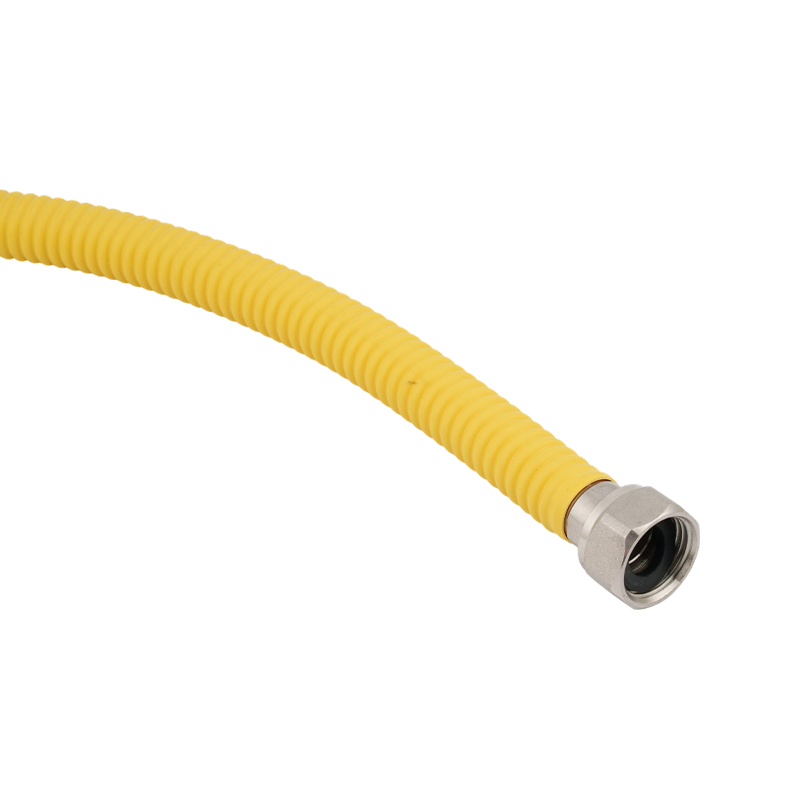
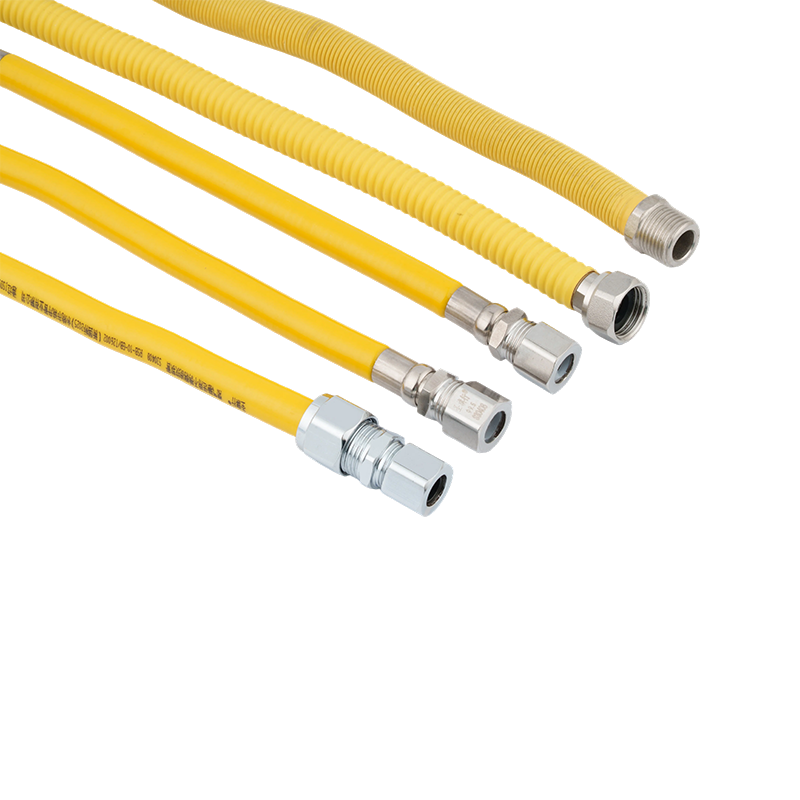
Corrugated Stainless Steel Tubing occupies a distinct niche. It is not a rigid pipe, and it is not a hose. It is a continuously annealed, corrugated, 300-series stainless tube, usually covered with a yellow or black polymeric jacket, supplied in coils and joined with mechanical fittings. The corrugation gives it flexibility, which means a single continuous run can pass through floor joists, wall cavities and ceiling plenums without intermediate joints.
The trade-off is that flexibility brings its own rules. Corrugated Stainless Steel Tubing must be bonded to the grounding electrode system, must be protected by a conduit sleeve where it passes through masonry or metal studs, and must not be installed in contact with sharp edges or in concealed locations that are inaccessible for inspection. It also carries a minimum bend radius and a maximum support spacing that vary by manufacturer listing. In practice, many projects use rigid Stainless Steel Gas Pipe for the visible riser and Corrugated Stainless Steel Tubing for the concealed branch, combining the durability of one with the routing speed of the other.
0.2 mmMinimum wall thickness for jacketed corrugated tube in low-pressure meter-set applications
10 kPaTypical upper working pressure limit for downstream corrugated tube systems
-15 to 60 °CCommon ambient temperature range for jacketed corrugated gas tubing
What Material Shall Not Be Used for Gas Piping
What material shall not be used for gas piping is not an academic question. Substituting an unapproved material is one of the most common causes of failed inspections and, in the worst cases, of leakage. The prohibited list is short but strict, and it is worth reading item by item because several of the materials below are perfectly acceptable in water and drainage service, which is exactly why they get mistakenly reused.
Cast Iron Pipe
Explicitly prohibited for gas service under NFPA 54 clause 5.5.2.1. The material is brittle, difficult to join gas-tight, and vulnerable to cracking from ground movement.
PVC and CPVC Plastic Pipe
Polyvinyl chloride and chlorinated polyvinyl chloride pipe, tubing and fittings are not permitted for gas conveyance in any diameter.
Aluminum Alloy 5456
Aluminum piping has a narrow permitted scope, and alloy 5456 is excluded entirely. Aluminum is also barred from outdoor and underground gas installations.
Copper Where Sulfur Is High
Copper and copper alloy pipe must not be used where the gas contains more than 0.3 grain of hydrogen sulfide per 100 standard cubic feet, or 0.7 mg per 100 liters.
Zinc Alloy Fittings
Zinc-aluminum alloy fittings are prohibited in systems that may contain a flammable gas and air mixture, because of the risk of spark generation during mechanical failure.
Zinc Coating as Burial Protection
Galvanizing or zinc coating is not recognized as adequate corrosion protection for underground gas piping. A dedicated coating or cathodic system is required instead.
The practical lesson is that a material approved for water is not automatically approved for gas. Approval rests on three pillars: chemical compatibility with the gas and its odorants, mechanical behavior under pressure and thermal cycling, and the ability to produce a verifiable leak-tight joint. PVC satisfies none of the three. Cast iron satisfies none of the three. Stainless Steel Gas Pipe satisfies all three when the grade and wall thickness are correctly matched to the service.
How to Cut Stainless Steel Gas Pipe Without Compromising the Joint
Knowing how to cut stainless steel gas pipe properly is what separates a system that passes its pressure test on the first attempt from one that leaks at commissioning. Stainless steel work-hardens. It also contaminates easily. A cut that looks acceptable to the eye can leave a burr that prevents a fitting from seating, or deposit free iron on the cut face that becomes a corrosion initiation site within months.
Power Saw Cutting
A saw with a blade rated for stainless steel produces a clean, square cut. The blade must never have been used on carbon steel, because embedded iron particles transfer to the stainless surface and trigger rust staining. After cutting, both the internal and external burrs must be removed.
Abrasive Wheel Cutting
When an abrasive wheel is used, it must be a wheel dedicated to stainless steel. Standard carbon steel cut-off wheels contain iron-based abrasive binders that contaminate the cut face. Wheel speed must match the wheel rating, and the wheel must not be forced, since heat buildup can alter the metallurgy of the cut edge.
Roller Cutting
Roller cutting works on stainless steel, but the reaction differs from carbon steel or copper. A dull wheel, or one intended for another material, tends to raise a lip on the cut end and can reduce the outside diameter below the minimum required for the fitting. Cutting wheels should be inspected and replaced on schedule.
Plasma Arc Cutting
Plasma arc cutting is recognized for stainless steel in larger diameters. It produces a heat-affected zone that must be dressed back to clean metal before joining, and the cut face should be inspected for dross and oxide before assembly.
Corrugated Tubing Cutting
Corrugated Stainless Steel Tubing requires its own cutter. The cut should be made in the valley of a corrugation, never on a crest, so the fitting can compress the tube correctly. After cutting, the tube end must be re-rounded, deburred and checked for squareness.
End Preparation
The cut end must be perpendicular to the tube axis. A common acceptance rule is that the end-face deviation must not exceed 1 percent of the outside diameter, and never more than 3 mm in absolute terms. Any deviation beyond that will produce an uneven seal and a joint that fails under thermal cycling.
Step sequence for a clean cut and a reliable joint
01
Measure and mark the cut line with a wrap-around marker or a purpose-made tube marker to keep the line square around the full circumference.
02
Select a cutting tool reserved for stainless steel. Confirm the blade or wheel has never contacted carbon steel.
03
Cut with steady, moderate feed. Excessive speed generates heat and can work-harden the cut edge, making deburring harder.
04
Deburr the internal and external edges with a stainless-rated deburring tool. Do not use a carbon steel file, which deposits iron.
05
Clean the cut end with a dedicated stainless brush or a lint-free wipe. Remove all cutting debris and metallic dust.
06
Verify squareness against the tube axis and check the outside diameter at the cut end against the fitting manufacturer's tolerance.
07
Assemble the joint immediately after preparation. Leaving a freshly cut stainless surface exposed in a humid or chloride-bearing atmosphere invites flash rusting.
Joining Methods for Stainless Steel Gas Pipe
The joining method determines the pressure rating, the inspection burden and the long-term reliability of the system. Four methods dominate gas service, and each has a defined envelope.
Joining Method
Diameter Range
Pressure Capability
Inspection Requirement
Typical Application
Tungsten Inert Gas Welding
All diameters
Full pipe strength
Visual, dye penetrant or radiographic
Risers, headers, high-pressure drops
Press Fitting (Mechanical)
Up to DN50 preferred
Per fitting listing, ANSI LC 4 / CSA 6.32
Visual check of press indicator
Indoor branch lines, concealed runs
Compression Ring Fitting
Small diameter
Per fitting rating
Torque verification
Instrument connections, meter sets
Brazing
Small to medium
Filler melting point above 538 °C
Visual and leak test
Copper-to-stainless transitions
Two rules apply regardless of method. First, when a stainless pipe connects to a dissimilar metal in a location where an electrolyte may be present, a dielectric transition piece or an insulating union must be installed to break the galvanic couple. Second, press fittings must be confirmed with a calibrated press tool and an inspection gauge; a partially completed press is one of the few failure modes that a visual inspection cannot reliably detect.
Wall Thickness Selection by Location
Wall thickness is where most specification errors occur. Designers sometimes carry over a thickness from a low-pressure indoor run into a riser or a service entry without recalculating. The table below presents the minimums commonly applied in city gas distribution practice.
Pipe Location
Minimum Wall Thickness
Reason for the Requirement
Indoor riser, multi-storey building
3.0 mm
Resistance to accidental impact and to thermal movement over the building height
Service entry pipe
3.5 mm
Higher external loading where the pipe crosses from outdoor to indoor environments
Jacketed corrugated tube, downstream of meter
0.2 mm
Low working pressure and full-length jacket protection
Buried or embedded run
Project-specific, per soil and loading analysis
External soil pressure, potential mechanical damage during subsequent excavation
Thickness also affects the choice of joining method. Very thin walls cannot be reliably welded in the field without burn-through, which is why press fittings are common on thin-wall stainless gas tube and welding is reserved for heavier schedules. A well-prepared specification states the thickness and the joining method together, rather than leaving the second to the installer's judgment.
Corrosion Performance Over Time
Relative performance retention in a chloride-bearing exterior environment, indexed score over 20 years
The divergence in the chart is the entire economic argument for Stainless Steel Gas Pipe in exposed or aggressive locations. Both materials begin with a high performance index. The stainless curve is nearly flat because the passive chromium oxide layer regenerates when damaged, provided oxygen is available. The carbon steel curve declines steadily as the surface converts to iron oxide, with the rate accelerating once the corrosion product becomes thick enough to flake and expose fresh metal underneath. In a location where access for repainting or replacement is difficult, the flat curve is worth the material premium.
Quality Control Checks on a Stainless Steel Gas Pipe Order
Material performance depends on the pipe arriving exactly as specified. Six checks should be performed before any tube enters the installation sequence, and they apply equally to a single length and to a full project release.
Mill Certificate Review
Confirm the heat number, grade, standard, wall thickness and mechanical properties. Verify that tensile and yield values fall within the specification window.
Dimensional Inspection
Measure outside diameter, wall thickness and ovality at both ends. Check length against the order and confirm squareness of the cut ends.
Surface Examination
Look for scratches, roll marks, pits, scale and embedded iron. Any free iron on the surface will show as rust staining after a short exposure period.
Eddy Current Testing
Non-destructive testing of the tube body detects longitudinal and transverse defects that visual inspection cannot reveal.
Hydrostatic or Pneumatic Test
Each length or a defined sample lot is pressure-tested to confirm the tube wall integrity and the soundness of the weld seam on welded product.
Spectrometric Verification
Optical emission spectrometry confirms the chemical composition of the actual material, catching grade substitution before installation begins.
Installation Conditions That Affect Long-Term Performance
Two installations using identical Stainless Steel Gas Pipe can have very different service lives because of how they were installed. Several conditions deserve attention during layout and fit-up.
Support spacing must be respected. Stainless tube has a lower stiffness than carbon steel of the same wall, so it sags further between supports and deflects more under thermal expansion. Spacing should follow the project specification rather than being copied from a carbon steel installation.
Where the pipe passes through a sleeve, a thermoplastic protective wrap should be applied to the pipe section inside the sleeve. A common rule is that the wrap extends at least 20 mm beyond each end of the sleeve, so the pipe never contacts the sleeve wall directly. This prevents abrasion and eliminates a potential galvanic contact point.
Electrical continuity matters. Corrugated Stainless Steel Tubing and any conductive gas piping must be bonded so that fault current and lightning surge have a defined path to ground rather than arcing across a joint. Gas piping should be kept at least 150 mm from parallel electrical cable runs, and crossings should maintain a similar separation.
Pressure testing should be performed with the medium and at the pressure specified for the project. Stainless systems are frequently tested with dry air or nitrogen. Where water is used for hydrostatic testing, the system must be drained and dried thoroughly afterwards, because residual chlorides in standing water are one of the few things that can attack 304 stainless in a short time.
Frequently Raised Points in Specification Review
Is Stainless Steel Gas Pipe approved for all pressure classes?
No. Approval is tied to wall thickness, grade and joining method. Medium-pressure indoor distribution and low-pressure downstream service are the most common applications. Higher pressure transmission lines typically remain carbon steel because the required stainless wall thickness makes the material cost uncompetitive.
Can stainless steel pipe be used for natural gas in coastal buildings?
Yes, and this is one of its strongest use cases. Grade 316 or 316L should be specified rather than 304, and exterior runs should be inspected periodically for chloride deposits that can accumulate in sheltered corners.
Does stainless steel react with the odorant added to natural gas?
Austenitic stainless steels are chemically compatible with the mercaptan odorants used in utility gas at normal concentrations. This is one of the reasons the material is favored over copper in high-sulfur gas streams.
Why does stainless steel sometimes show rust stains?
In nearly all cases the stain is not the stainless steel corroding. It is free iron deposited on the surface by a carbon steel tool, a contaminated abrasive wheel or airborne grinding dust. Removing the deposit and passivating the surface resolves the appearance.
How should Stainless Steel Gas Pipe be stored on site?
Store it indoors or under cover, off the ground, with the ends capped. Keep it away from carbon steel fabrication areas where grinding sparks and iron dust are produced. Do not use carbon steel chains or slings for lifting.
Product Range and Customization for Gas Projects
Stainless Steel Gas Pipe for gas service is produced in a defined range of dimensions and finishes so that the material arriving on site matches the specification without additional processing. The table below lists the parameters most often defined in project documentation.
Parameter
Available Range
Notes
Grade
304, 304L, 316, 316L
316L recommended for welded assemblies and coastal locations
Outside diameter
6 mm to 219 mm
Larger diameters available as welded and drawn product
Wall thickness
0.5 mm to 12 mm
Minimum 3 mm for risers, 3.5 mm for service entries
Manufacturing route
Seamless or welded
Seamless preferred for high-pressure and cyclic service
Surface finish
Pickled, annealed, bright annealed, polished
Pickled and passivated finish is standard for gas service
Length
Fixed length or cut to project requirement
Cut lengths reduce on-site waste and handling damage
End preparation
Plain end, beveled, threaded
Beveled ends for welding, plain ends for press fittings
Testing
Eddy current, hydrostatic, spectrometric
Test certificates supplied with each release
Packaging
Wooden case, steel frame, end caps
End caps prevent moisture and particulate ingress during transit
For projects with unusual geometry, tube can be supplied bent, flared or pre-assembled into spools. Pre-assembly moves welding and inspection from a congested site into a controlled workshop, which improves joint quality and shortens the installation window. Cut-to-length supply removes the cutting step entirely, which also removes the risk of iron contamination from an on-site abrasive wheel — the single most common cause of surface rust complaints on new stainless installations.
Choosing Between Rigid Pipe and Flexible Tubing on the Same Project
Most well-designed gas systems use both. Rigid Stainless Steel Gas Pipe handles the visible, exposed, mechanically vulnerable sections: exterior risers, meter connections, equipment room headers and any run where impact damage is possible. Corrugated Stainless Steel Tubing handles the concealed, tortuous, low-pressure branches where every avoided joint is one less potential leak path.
Rigid Stainless Steel Gas Pipe
Higher impact resistance and better dimensional stability
Welded or pressed joints with predictable pressure ratings
Preferred for risers, headers and exposed exterior runs
Requires more fittings and more installation time per meter
Corrugated Stainless Steel Tubing
Long continuous runs with minimal joint count
Fast routing through framing and confined spaces
Requires bonding, sleeve protection and bend radius control
Best suited to low-pressure downstream of the meter
The combination is not a compromise. It is a deliberate allocation of each material to the duty it performs best, and it typically produces the lowest total installed cost over the life of the system. A rigid riser that survives fifty years of weather, feeding a flexible branch that reaches every appliance without a single concealed joint, is a configuration that satisfies both the inspector and the building owner.
When the specification is written around verified standards, correct grade selection, appropriate wall thickness and disciplined cutting and joining, Stainless Steel Gas Pipe delivers a service life that outlasts most of the building systems around it. The material itself is rarely the cause of a failure. The cause is almost always a decision made earlier — a substituted grade, a thin wall in a loaded location, a cut made with the wrong wheel, or a joint pressed with an uncalibrated tool. Each of those decisions is avoidable, and each of them is cheaper to avoid than to correct.



 English
  中文简体
中文简体  عربى
عربى  Español



 Wholesale Flexible Metal Hose Manufacturers