Yuyao Shengchuang Pipe Industry Co., Ltd. manufactures the Steel-Wire Braided Hose range at our own 30,000 m² plant in Yuyao Jiangnan Plumbing City, Zhejiang. Every hose in this family is reinforced with pure 304 austenitic stainless steel wire woven at a 54° braid angle, with no non-metallic reinforcement component in the braid layer. We build these assemblies for gas appliance connections, hot and cold water lines and light industrial flexible piping, where pressure containment, vibration life and moisture resistance carry more weight than the lowest possible unit cost.
304 Stainless Wire Braid: What the Reinforcement Layer Delivers
The braid is the load-bearing and protective layer of the hose. Weaving at 54° holds the wire at the angle that best resists axial extension under internal pressure while still supporting the core through repeated flexing. Because the layer is entirely metallic, it cannot chalk, absorb water or degrade the way a textile or hybrid reinforcement can.
- Pure 304 austenitic wire, 54° braid: no non-metallic reinforcement in the braid, so tensile strength and burst pressure run 25%–30% higher than our hybrid-wire equivalents, with a wider safety margin at the same bore.
- Corrosion and weathering stability: resistant to chloride-ion attack, UV exposure and humid air, which suits bathrooms, basements, commercial kitchens and sheltered outdoor connection points.
- Fire and heat behaviour: superior flame retardancy compared with mixed-filament constructions, with no non-metallic material in the reinforcement to soften or burn through.
- Vibration and impact resistance: the specification we recommend for lines at or above 0.8 MPa working pressure and for equipment that cycles or vibrates in normal service.
Our Steel-Wire Braided Hose Range
Two standard builds cover most gas and water connection points, and both can be adapted in length, bore and connector style for project quantities. We supply them alongside our wider braided and gas pipeline programme, so a mixed order ships on one delivery.
| Model / build |
Braid and core |
Connection and sealing |
Application fit |
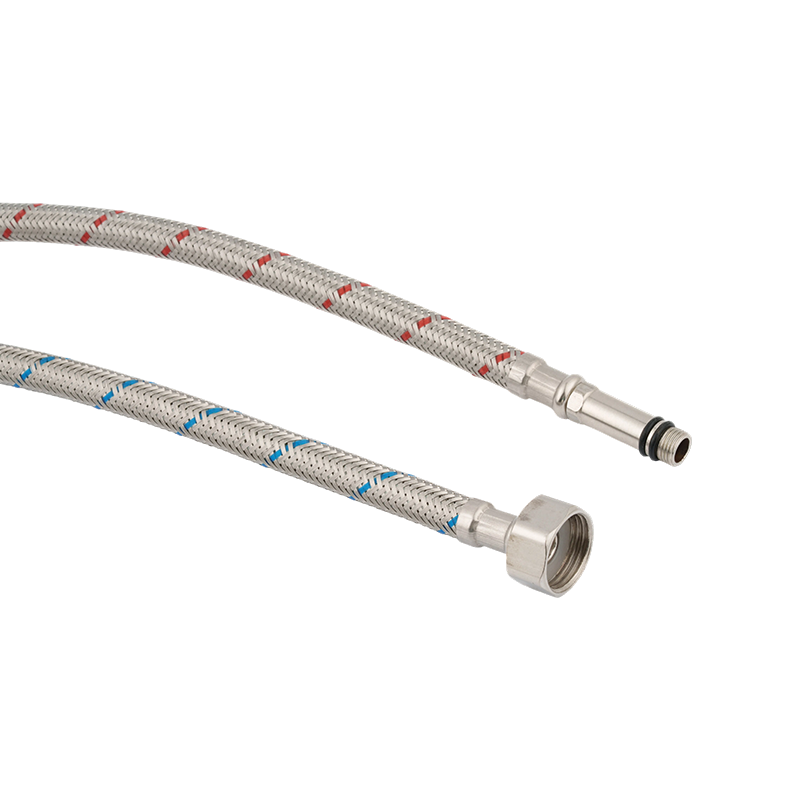
| High-Pressure O-Ring Sealed Dual-Temperature Braided Hose |
Pure 304 wire braid at 54°, no non-metallic reinforcement |
O-ring sealed end connection that holds through thermal cycling |
Water heaters, wall-hung boilers, vibrating appliance lines, combined hot and cold service |
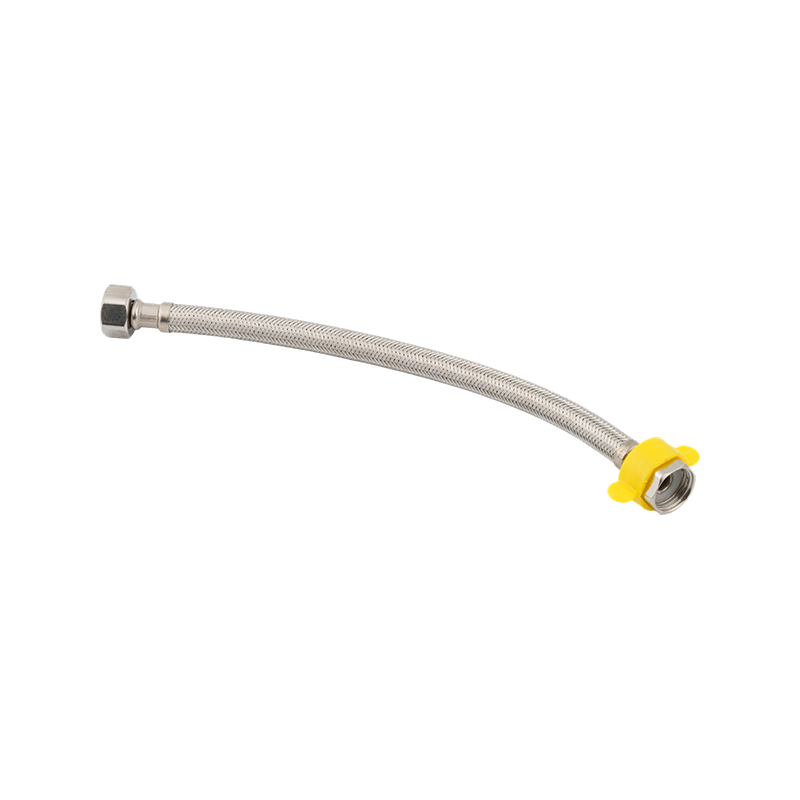
| Rapid-Connect Stainless Steel Braided Hose with Thread Protection |
304 wire braid over a flexible core, fittings assembled on the automated line |
Rapid-connect coupling with protected male threads |
Service access points, retrofit and maintenance work, commercial kitchen and outdoor connections |
| Custom-configured braided assemblies |
Braid, core and length set to the working point |
Connector style, thread and seal matched to the appliance or manifold |
OEM appliance supply, project batches, distributor stock programmes |
Application Fit Across Gas and Water Systems
Steel-wire braid is our recommendation wherever the line runs hot, vibrates, or sits in damp and chloride-bearing air. Hybrid or textile-reinforced hose remains a sound choice for dry, low-pressure indoor runs where flexibility and cost dominate — that work is covered by our Mixed-Filament Braided Hose range.
- Gas water heaters and wall-hung boilers: continuous thermal cycling and burner vibration, connected to gas stoves and other household gas appliances.
- Commercial kitchen equipment: grease-laden air, frequent movement and cleaning cycles.
- Humid, coastal and corrosive rooms: bathrooms, basements and utility areas where chloride ions attack ordinary reinforcement.
- Outdoor piping connections: UV exposure and temperature swing, where an all-metal braid keeps its properties.
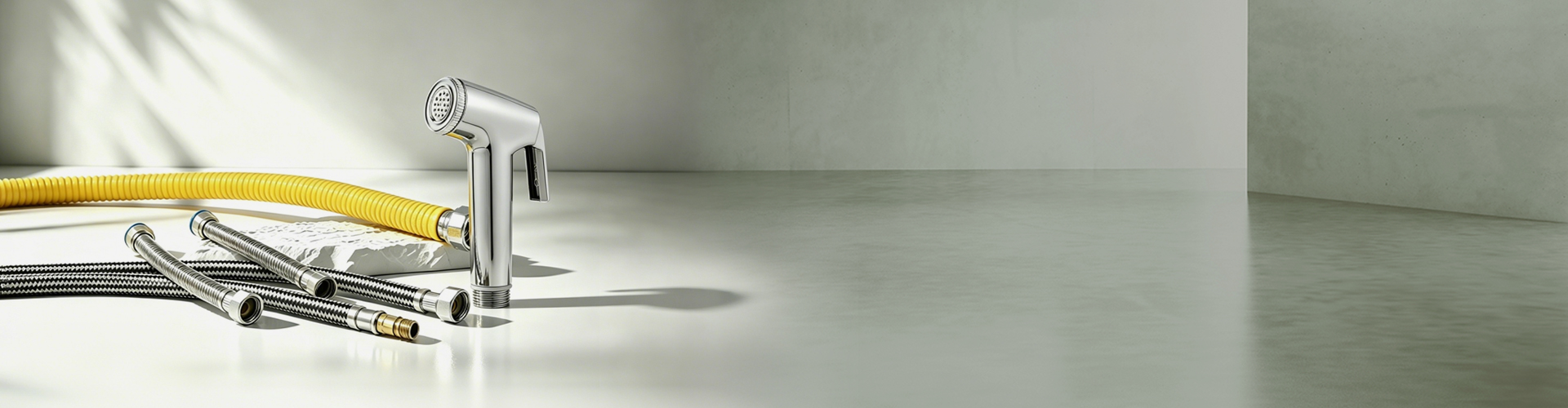
- Bidet and spray assemblies: supplied as matched hose-and-sprayer sets for sanitary projects.
- Light industrial flexible lines: where a stainless corrugated core is needed, our 304 Stainless Steel Corrugated Pipe and flanged metal hose cover larger bore and higher movement.
Configuration, Connection and Line Integration
We configure each assembly around the working point, the appliance interface and the way the installer will reach the connection. Length, bore, connector type and seal are fixed before production, and the same parameters are recorded on the batch documents.
- Length and bore: fixed-length assemblies for OEM and retail pack formats, or loose coils for contractors who cut on site.
- End connections: threaded male and female fittings, rapid-connect couplings, and O-ring sealed ends for repeated thermal cycling.
- Thread protection: protective caps or covers on exposed threads, as used on the Rapid-Connect Stainless Steel Braided Hose with Thread Protection, keeping sealing faces clean through transport and storage.
- Sealing strategy: O-ring, gasket or metal-to-metal, selected to the gas or water medium and the mating port surface.
- Appliance integration: fittings positioned so the hose takes up the bend radius without pulling on the inlet, which is how we avoid kinked cores after installation.
Manufacturing, Automation and Quality Control
As a China-based manufacturer of stainless steel gas pipeline products, we run pipe forming, welding, braiding and assembly on an integrated intelligent line supported by more than 40 high-precision automated welding machines. Automation is what keeps braid coverage, weld position and fitting alignment identical from the first piece to the ten-thousandth, and it removes the manual variation that shows up later as a leak or a loosened joint.
- Three-level inspection: raw material store sampling, in-process inspection at every station, and full inspection of finished goods before release.
- Dedicated QC on the line: quality personnel monitor each production process in real time and keep records per batch.
- Own laboratory: an independent standardization laboratory with pipe testing instruments and a senior R&D team working on sealing, structure and new material applications.
- Certification position: national 3C mandatory safety certification and ISO 9001 quality management system certification across the product line, with multiple domestic and international utility model and invention patents.
Testing, Acceptance and Documentation
Every finished assembly passes the checks below before it is packed. Test equipment includes tensile testing machines, swing fatigue testing machines and air tightness testers, and batch records are retained so a delivered lot can be traced back to its inspection data.
| Check |
What it confirms |
Stage |
| Incoming material sampling |
Wire grade, strip condition and fitting dimensions |
Raw material store |
| In-process inspection |
Forming, welding and braid coverage at each station |
Production line |
| Tensile test |
Fitting-to-hose joint strength and braid tensile behaviour |
Laboratory |
| Swing fatigue test |
Bending life under repeated flexing |
Laboratory |
| Air tightness test |
Leak-free sealing of the finished assembly |
Finished goods |
| Corrosion and surface check |
Performance in damp or chloride-bearing service |
Laboratory |
| Final full inspection |
Visual, dimensional and functional release of the batch |
Before packing |
Product safety performance is held to domestic gas industry standards, which allows the range to be presented for gas engineering acceptance in multiple regions. Where a project requires particular acceptance paperwork, that requirement is set at the quotation stage so the correct records travel with the shipment.
Installation, Maintenance and Spare Parts
- Handling: keep the braid free of sharp edges and support the hose so the bend stays inside its working radius rather than pulling tight against the appliance inlet.
- Sealing faces: leave thread protection in place until the moment of connection; a scored or grit-contaminated face is the most common cause of a weep at commissioning.
- Commissioning: leak-test the connection after tightening to the specified torque, then re-check after the first thermal cycle on boiler and heater installations.
- Service life: an all-metal braid does not age in the way textile reinforcement does, so replacement is normally driven by the fitting, seal or core condition rather than the braid.
- Spares: seals, gaskets and replacement assemblies in standard lengths are held in the warehouse for repeat orders.
Information We Use to Configure Your Solution
Our proposal is based on the working point, the material in contact and the production target. The following inputs let us fix the build and quote without a second round of questions.
- Medium and service: natural gas, liquefied gas, hot water or cold water, and whether the run is continuous or intermittent.
- Working conditions: normal and peak pressure, temperature range, vibration source and indoor or outdoor location.
- Interfaces: port thread standard, sealing face type, mating appliance or manifold, and any space limit at the connection.
- Geometry: required length, bore, minimum bend radius and whether the hose is coiled, bagged or boxed.
- Volume and format: OEM line supply, project batch, or distributor stock pack, with labelling and packing requirements.
- Acceptance: the test records, certification copies and inspection documents your project requires at handover.
Frequently Asked Questions
What makes steel-wire braid different from mixed-filament braid?
The reinforcement is 100% 304 stainless steel wire woven at 54°, with no non-metallic component. That gives 25%–30% higher tensile strength and burst pressure than our hybrid-wire alternatives, plus resistance to chloride ions, UV and weathering, and no risk of non-metallic degradation over time.
Which applications should specify the steel-wire version?
Lines at or above 0.8 MPa, high-vibration equipment such as water heaters and wall-mounted boilers, humid or corrosive rooms, commercial kitchen equipment and outdoor piping connections. Lower-pressure dry indoor runs can use our Mixed-Filament Braided Hose range instead.
Can you supply custom lengths and connector styles?
Yes. Our R&D and production teams adjust pipe specification, length and connector style to the appliance or manifold interface, and we can assist in developing a differentiated product for OEM and distributor programmes.
How is batch consistency maintained?
Production runs on an integrated intelligent line with more than 40 automated welding machines, under a closed-loop inspection system covering material sampling, in-process checks and full finished-goods inspection. Test records are kept per batch, so different lots perform the same way.
What certifications and inspection records accompany the goods?
The product line holds national 3C mandatory safety certification and ISO 9001 quality management system certification, and we hold multiple domestic and international patents. Batch test records from our laboratory, including tightness, tensile and fatigue results, can be supplied with the shipment.
What are your lead times for standard and urgent orders?
Regular specification hoses are held in stock year-round, and the warehouse ships an average of 10,000 pieces per day with standard in-stock orders arranged within 48 hours. Urgent engineering and replenishment orders are scheduled with priority through our 7×16-hour customer service desk.



 English
 中文简体
 عربى
 Español






 Custom Steel Wire Braided Hose Manufacturers