Yuyao Shengchuang Pipe Industry Co., Ltd. is a 304 Stainless Steel Corrugated Pipe manufacturer working from Yuyao Jiangnan Plumbing City in Zhejiang, China, a plumbing industrial cluster with complete local supporting facilities. Since 2015 we have concentrated on safe gas pipeline products: stainless steel gas pipe, metal-coated pipe for gas service, stainless steel corrugated hose and the fittings that complete a run. Research, production, testing, warehousing and delivery sit inside our own 30,000 m² plant, so corrugated pipe leaves us as a tested assembly rather than a cut length of tube.
The corrugated range belongs to our Industrial Hoses family and answers one specific duty: carrying gas where the connection point moves. Wall-hung boilers, water heaters, gas stoves and packaged equipment all generate vibration, thermal expansion or assembly tolerance that rigid pipe cannot absorb. Corrugation supplies the flexibility, the 304 wall supplies corrosion resistance and pressure containment, and a wire braid, where the duty calls for it, controls axial extension under pressure.
Range at a glance
- 304 (06Cr19Ni10) austenitic corrugated core, hydraulically formed from argon-arc welded strip tube
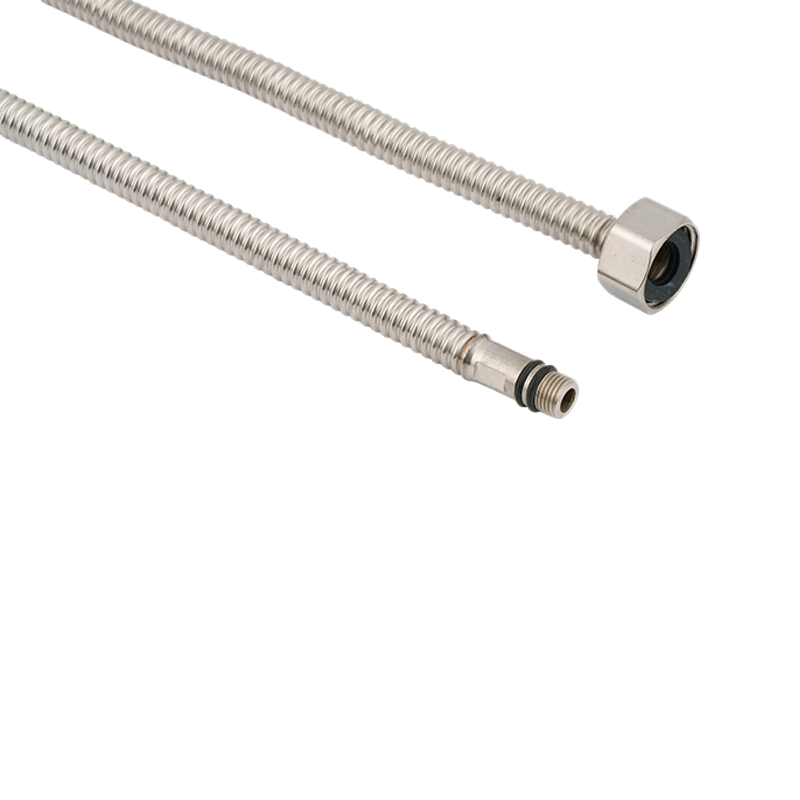
- Anti-vibration and precision double-threaded corrugated hose as standard built types
- Wire-mesh braided reinforcement for higher-pressure corrugated hose
- Finished lengths, connector styles and jacket options built to the confirmed drawing
Our 304 Stainless Steel Corrugated Pipe Range
The category covers two published corrugated hose types, the mesh-braided variants built on the same core, and the flanged construction we produce for larger plant-side connections. Every one of them starts as a corrugated 304 tube; the differences lie in reinforcement, end connection and how the assembly is fixed along the route.
| Hose type |
Core and reinforcement |
End connection |
Typical installation |
| High-Strength Anti-Vibration Stainless Steel Corrugated Flexible Hose |
304 corrugated core with metal wire braided mesh |
Threaded fittings, fixed length |
Appliance and boiler connections, pump, fan and blower take-off where vibration must be isolated from the fixed line |
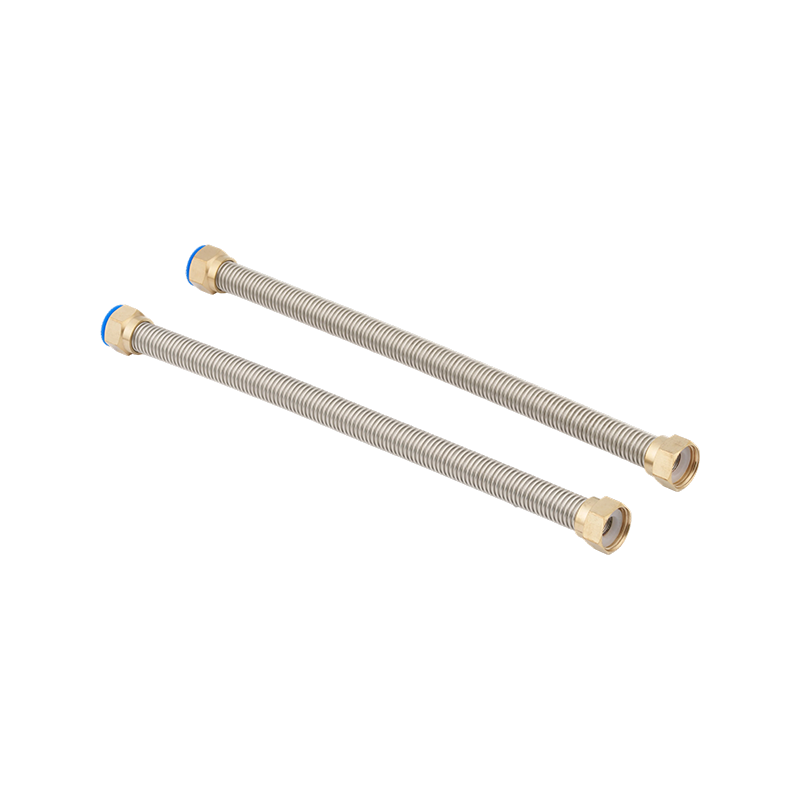
| Industrial-Grade Precision Double-Threaded Corrugated Hose |
304 corrugated core, double-threaded terminations |
Male/male threaded, controlled overall length |
Gas appliance hook-up, equipment panels, repeatable connections on assembly lines |
| Mesh-braided corrugated hose |
304 corrugated core with braided wire mesh over the corrugation |
Threaded ends or welded to the specified fitting |
Higher working pressure service and exposed routing where the braid also resists abrasion |
| Flanged Metal Hose |
Corrugated 304 core with braid as required |
Fixed or loose flange to the specified standard |
Larger bore plant piping, flanged equipment nozzles and expansion compensation between fixed points |
Material and Construction of the Corrugated Core
304 is the austenitic chromium-nickel grade designated 06Cr19Ni10 in Chinese standards and SUS304 under JIS. A typical composition of 18–20% chromium and 8–10.5% nickel provides the corrosion resistance and formability the corrugation process needs, along with the durability and clogging resistance that matter in building service. We take austenitic strip, slit it longitudinally, argon-arc weld it into tube, solution-treat it and then hydraulically corrugate the wall.
- Wall thickness and corrugation pitch set the balance between flexibility and pressure retention.
- Corrugation depth and pitch also determine pressure drop across the assembly.
- A braided mesh over the corrugation raises pressure capability and restricts axial stretch.
- Assemblies are produced to a fixed length so installed geometry repeats piece to piece.
- Pipe forming, welding, wrapping and assembly run on our automated lines rather than at individual benches.
Application Fit
Corrugated hose earns its place wherever a line must tolerate movement between two fixed points, or where the final connection is made after the rigid pipework is already installed.
- Household gas appliances. Gas stoves, water heaters and wall-hung boilers, where the appliance position and the supply point rarely align perfectly.
- Building services. Final connections at meters, risers and appliance manifolds where thermal movement accumulates along the run.
- Light industrial gas trains. Burners, ovens, packaged rooftop units and laboratory benches that need a demountable, vibration-tolerant link.
- Vibration isolation. Compressors, blowers, pumps and mechanical rooms, where the hose interrupts the path that would otherwise carry vibration into the pipework.
- Retrofit and prefabrication. Assemblies prepared off site to a fixed length and fitted at commissioning without field bending.
Configuration Options We Build To
- Bore and length. Nominal bore and overall length stated as installed between connection faces.
- Reinforcement. Bare corrugated core, or single wire-mesh braid where pressure or axial restraint requires it.
- End connections. Male or female threaded, fixed-length threaded ends, or flanged terminations to the standard the receiving equipment uses.
- Jacket. Bare 304, or a safety-coated outer jacket that adds abrasion protection and colour identification for gas service.
- Pressure class. Working and test pressure confirmed against bore, wall, corrugation profile and braid type before release.
- Service conditions. Medium, ambient and media temperature, indoor or exposed installation, and any cleaning or wash-down exposure.
- Routing limits. Minimum bend radius and the straight length needed at each end for the fittings to seat.
Testing, Acceptance and Batch Records
Our quality system is a closed loop with a three-level inspection mechanism: sampling of raw material on receipt, in-process inspection at each production stage, and full inspection of finished goods before they leave the factory. Dedicated quality control personnel monitor every process in real time, and complete test records are kept for each batch so that performance stays consistent between production runs.
| Stage |
What is checked |
Equipment and evidence |
| Incoming material |
Strip grade and dimensional sampling on receipt |
Standardised in-house laboratory and sampling records |
| In-process |
Weld quality, corrugation forming, braid and jacket wrapping, assembly |
Automated welding stations with dedicated inspection personnel per process |
| Finished goods |
Air tightness, pressure sealing, tensile strength, bending life and corrosion resistance |
Tensile testing machines, swing fatigue testing machines and air tightness testers |
| Batch release |
Full inspection before shipment, deviation control against the drawing |
Batch test records retained and issued with the delivery |
The full product line holds national 3C mandatory safety certification and ISO 9001 quality management system certification, and our independent development work has produced a number of domestic and overseas utility model and invention patents. Product safety standards follow domestic gas industry standards and can be aligned with the acceptance requirements of gas engineering in multiple regions.
Capacity, Stock and Delivery
Our production workshop runs more than 40 high-precision automated welding machines alongside an integrated intelligent assembly line, covering forming, welding, wrapping and assembly. Automation holds welding accuracy steady and removes the manual variation that affects sealing, tensile resistance and bending performance.
Regular specifications are held in a large finished goods storage centre throughout the year. Average warehouse shipment reaches 10,000 pieces per day, standard in-stock orders are arranged for delivery within 48 hours, and our customer service team is online 7 × 16 hours for urgent engineering and replenishment orders, coordinating capacity and prioritising scheduling when a site is waiting.
Information We Use to Configure Your Solution
A corrugated hose assembly is defined by the working point, not by a catalogue number alone. The following inputs let us fix bore, wall, corrugation, braid and terminations and return a quotation that matches the installation.
- Medium and duty: natural gas, liquefied gas, mixed gas or water service, and whether the line is continuous or intermittent.
- Pressure: normal working pressure, maximum transient pressure and the test pressure required at site acceptance.
- Geometry: nominal bore, installed length between connection faces, routing, available bend radius and the space at each end.
- Movement to absorb: vibration amplitude and frequency at the take-off point, thermal growth of the adjacent rigid run, or a fixed offset between two nozzles.
- Temperature: media temperature and ambient conditions at the installed location, including exposure to sunlight or frost.
- Connections: thread standard and size, flange standard and rating, or the mating fitting drawing from the appliance or equipment manufacturer.
- Finish and identification: bare 304 or safety-coated jacket, colour coding and any permanent marking required on the assembly.
- Documentation: batch test records, conformity documents and certification needed for project handover.
- Commercial scope: packaging format, labelling, delivery point and the annual volume or release schedule behind the order.
Installation, Serviceability and Delivery Scope
- Install the assembly at its manufactured length: corrugated hose should not be stretched to reach a connection or compressed into a gap.
- Keep the corrugation and braid out of load paths; support the line so the assembly weight does not hang on the threaded joints.
- Respect the stated minimum bend radius and avoid twisting the core during tightening. Use the fitting flats, not the hose, to apply torque.
- Inspect braid and jacket at routine service intervals; abrasion, corrosion staining or a loose braid indicate the assembly should be replaced.
- Replacement assemblies are produced to the same drawing and batch-controlled, so a spare matches the piece already installed.
- Packaging is agreed per order, from individual cartons and poly-bagged pieces to palletised bulk, with labels matching the destination and the drawing reference.
Frequently Asked Questions
What decides whether a corrugated hose is used instead of rigid stainless steel gas pipe?
Movement. Where vibration, thermal growth or a fixed misalignment exists between two connection points, corrugation absorbs it within the hose body, while rigid pipe would transmit the load into joints and supports. Where the run is straight, fixed and undisturbed, rigid stainless steel gas pipe remains the simpler choice.
Can the corrugated hose be supplied with wire braid and a protective outer jacket?
Yes. The wire-mesh braided construction adds axial restraint and raises pressure capability over the bare corrugated core. A safety-coated outer jacket can be added over the braid for abrasion protection and colour identification of gas service.
How are lengths and end connections fixed?
We build to the installed length you specify between connection faces, with male or female threaded ends, fixed-length threaded ends or flanged terminations. The thread or flange standard comes from the equipment or meter it has to mate with, and is confirmed on the drawing before production.
What testing does each batch carry before shipment?
Finished corrugated hose goes through air tightness and pressure sealing checks, tensile testing and swing fatigue testing in our in-house laboratory, alongside corrosion resistance assessment. Results are recorded per batch and issued with the delivery.
Do you support customised corrugated hose development?
We do. Our R&D team adjusts pipe specifications, lengths and connector styles to your requirements and works with customers on differentiated variants, including jacket colour, marking and packaging specific to a distribution programme.
What lead time applies to standard and custom corrugated pipe orders?
Regular in-stock specifications are arranged for shipment within 48 hours from our warehouse, which dispatches an average of 10,000 pieces per day. Custom lengths, connector styles and coated variants are scheduled once the drawing is confirmed, and urgent engineering orders can be prioritised through capacity coordination.



 English
 中文简体
 عربى
 Español






 Custom 304 Stainless Steel Corrugated Pipe Manufacturers